


 Deutsch
 Italiano
 Français
Uncategorized
Perfect Pedal Position
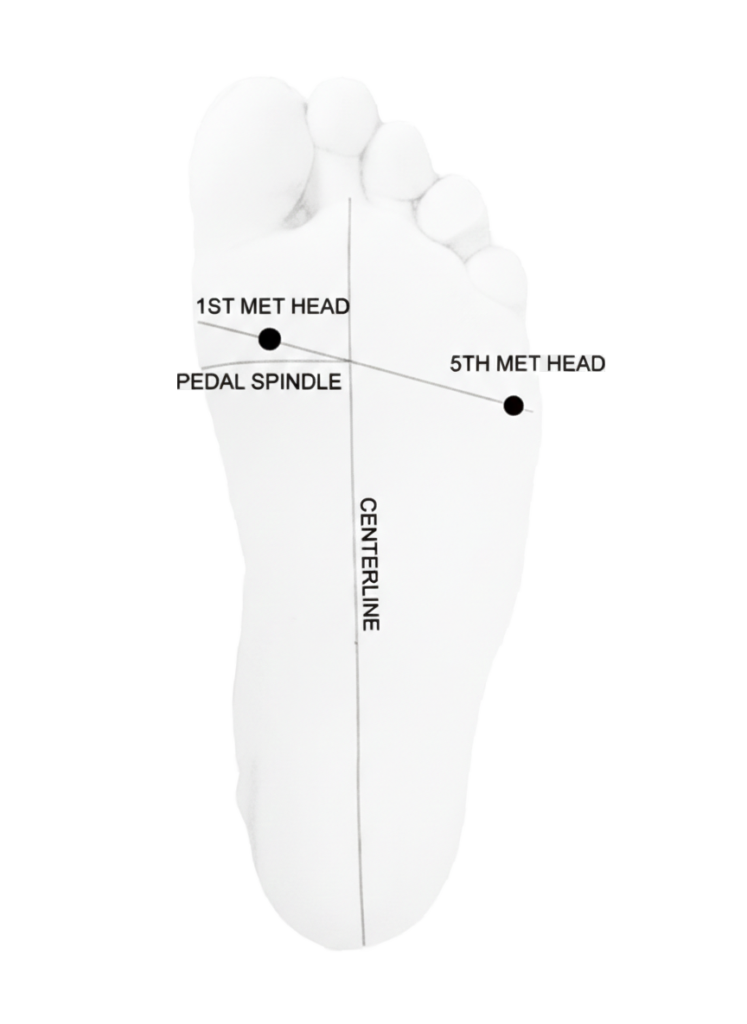
The Myth of the “Perfect” Pedal Position (And How to Find Yours)
Hands on the bars, bum on the saddle. We spend hours obsessing over stem length and saddle height, but often ignore the engine room of the ride: the feet. The foot-pedal interface is critical for power transfer, balance, and preventing injury.
Is there one “perfect” foot position? The short answer is no. The “perfect” position depends heavily on your anatomy and, crucially, your riding style. What works for a criterium sprinter might wreck the knees of a downhill racer.
Here is a guide to dialing in your setup for Road, Gravel, and MTB, based on biomechanics and modern riding principles.
The Baseline: Understanding the “Neutral” Position
Before splitting into disciplines, we need a reference point. Historically, the golden rule was to place the pedal axle directly under the ball of the foot (the 1st metatarsal joint).
However, modern bike fitting has shifted toward a “Neutral” position. This places the pedal axle midway between the 1st metatarsal (ball of the foot) and the 5th metatarsal (the bony bump on the outside of the foot behind the little toe). This balances stability and leverage.
Road Cycling: The Pursuit of Efficiency
On the road, the goal is turning biological energy into mechanical propulsion with minimal waste.
- The Sprinter Racer: Riders doing short, high-power events often prefer the cleat slightly forward (moving the foot back). This positions the axle closer to the ball of the foot (1st metatarsal).
- Why? It increases leverage for rapid acceleration and high-cadence spinning.
- The Risk: This recruits more calf muscle to stabilize the foot, which can lead to fatigue or “hot foot” (numbness) over long distances.
- The Endurance/Gran Fondo Rider: For long days in the saddle, a rearward position (closer to the 5th metatarsal) is superior.
- Why? It reduces the workload on the calves and Achilles tendon, helping you sustain power longer without cramping.
Gravel: The Hybrid Approach
Gravel rides sit between the high-cadence spinning of road and the technical demands of MTB.
- The Setup: Most gravel riders benefit from the neutral to slightly rearward position used by endurance road cyclists. Stability is key when the terrain gets rough.
- The Magped Option: Gravel riders are increasingly looking for the efficiency of being “clipped in” without the panic of being trapped. Magnetic pedals (like the Magped Gravel) allow for a round pedal stroke (pulling up) but let you detach instantly in sketchier terrain.
- Tip: Because magnetic pedals allow some float, using a positioning plate on the shoe can help lock your foot into the exact same spot every time if you find the feeling too “floaty”.
MTB, Enduro & Downhill: The Mid-Foot Revolution
This is where the traditional “ball of the foot” rule completely breaks down.
For XC and uphill oriented riders the baseline/ neutral position like shown in the picture above is perfect to have the best power transfer to the crank while cycling.
The more you go for trails and downhill/gravity a Mid-Foot position reigns supreme!
In the picture below you can see the upper shoe showing the gravity / downhill position while the lower shoe showing a more XC and trail oriented position.
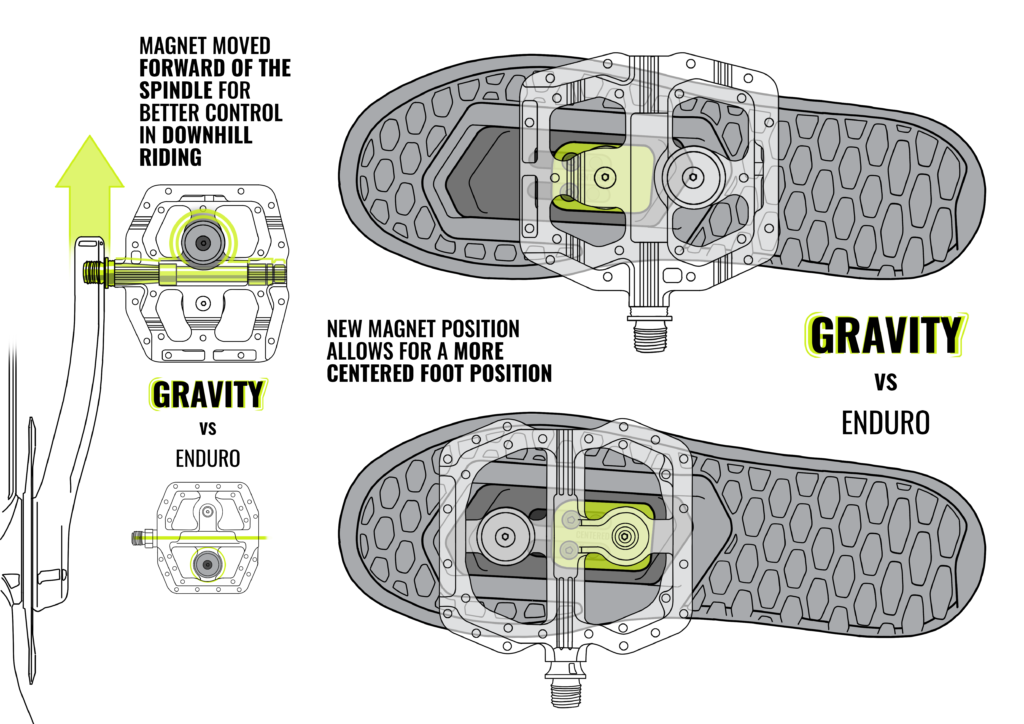
Depending on your riding you we have the perfect magped pedal for you:
the GRAVITY for gravity and downhill riders and the ENDRUO2 for XC and trail riders.
- The Science: When you walk or run, you push off the ball of your foot. But on a bike, your foot doesn’t leave the pedal. Studies show that the hips (glutes/hamstrings), not the quads, are the major drivers of the pedal stroke.
- Why Mid-Foot?
- Recruit the Hips: Moving the foot forward (axle closer to the arch) helps recruit the powerful hip muscles rather than over-taxing the calves.
- Dropped Heels: To maintain traction and stability on technical descents, you must drop your heels. This is physically difficult if your foot is balanced on your toes. A mid-foot position supports the arch, allowing you to drop your weight back and down for control.
- The Setup: Look for a position where the axle is behind the 5th metatarsal, moving toward the arch.
-
- Magped Enduro: For riders who want the stability of being clipped in but the safety of flats, the Magped Enduro provides a magnetic bond strong enough to pull on the upstroke , but releases instantly if you crash or need to dab a foot.
- Fine-Tuning: Lateral and Rotation
Once your Fore-Aft (front-to-back) position is set, don’t ignore the other two dimensions.
- Stance Width (Lateral): If you have wide hips, you generally need a wider stance width (feet further apart). If your knees flare out or cave in while pedaling, check your stance width. You may need to move your cleats sideways or even use pedal axle extenders.
- Rotation (Float): Very few people have feet that point dead straight. Most of us are slightly “duck-footed” (toes out, heels in).
- The Test: Sit on a high table and let your feet hang naturally. If your toes point out, your cleats should be rotated to match that natural angle.
- Knee Pain: Forcing a “duck-footed” rider to pedal with straight feet is a recipe for knee pain. Ensure your pedals have enough “float” (wiggle room) to accommodate your natural joint rotation.
Final Thoughts: Listen to the Body
If you experience numbness, calf cramping, or knee pain, your position is likely off.
- Pain at the front of the knee? Check if your saddle is too low or cleats are too far forward.
- Hot spots on the ball of the foot? Move the cleat back (foot forward) to distribute pressure.
Whether you are grinding gravel or sending downhill runs, remember: Comfort equals power. Don’t be afraid to experiment to find the position that lets you ride harder, longer.