Deutsch
 Italiano
 Français
Story
magped from the perspective of a former professional triathlete, physiotherapist and osteopath
Wolfgang Kattnig MSc DO
For over 10 years, from 1987 to 1996, I was one of Austria’s most successful triathletes. Even back then, I was very technically minded. My motto was: what’s optimized in the back room doesn’t have to be fought for in competition.
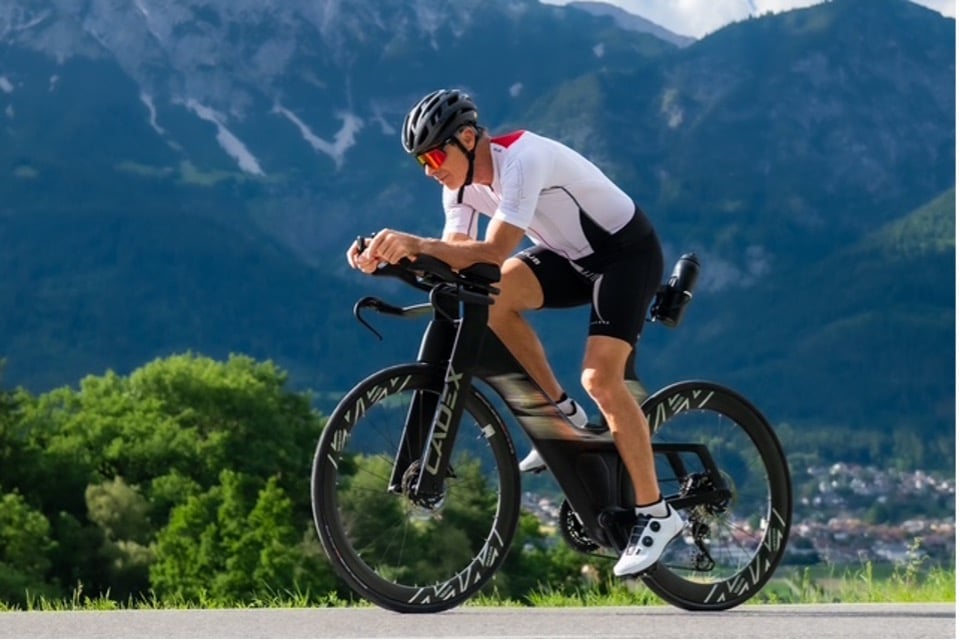
Over the last 30 years, a great deal has changed, especially in the cycling world. This is also true for pedals. With the Magped, I’ve discovered a pedal that I would almost call a game-changer. It’s easy to clip in and releases with just a slight outward movement of the knee. This is particularly convenient at intersections. If the traffic light changes, a slight inward movement of the knee secures it again; if not, simply lower your foot. Tipping over is virtually impossible. Weight-wise, it’s a perfect match for my new Cadex bike, the most aerodynamic machine on the market. While I no longer compete, I still want to show my former triathlete credentials.
From a physiotherapy perspective, these pedals offer optimal freedom of movement. The pedaling mechanism allows for free heel movement, which is very gentle on the knees. This movement is adjustable on the Magped, even asymmetrically if needed, which can be a significant advantage, for example, in cases of foot misalignment. Because release via rotation is not possible, unlike with standard clipless pedals, the foot can be rotated very far. However, this very release through forceful rotation can sometimes be problematic and painful, especially for older individuals. Patients with osteoarthritis are particularly affected. A twisting motion causes adjacent inflamed bone structures to collide, further stressing and irritating the knee. Any compression of the arthritic structures leads to further inflammation and thus to the progression of osteoarthritis. The same applies to patients with meniscus problems. Here, too, twisting movements should be avoided, as this was the original release mechanism. In both cases, the entire leg must be rotated to avoid stressing the knee. Any form of rotation in the knee leads to renewed stress. Here too, cycling is the best exercise to improve knee function, which might otherwise be negated when releasing the pedal. Therefore, the outward movement of the knee to release the Magped is not stressful because the rotational movement is avoided, thus protecting the knee.
The previously mentioned advantage of the Magped, namely its easy release when dismounting, is particularly beneficial because it prevents unintentional tipping over, especially elbow injuries and bruising in the pelvic area. Even less confident cyclists can use the easily released Magpeds without fear of injury.
- Triathlon professional 1987-1996
- 1987 | Winter Triathlon World Champion Villar de Lanse
- 1989 | 10th place at the 1st Triathlon World Championships in Avignon
- 1990 | 3rd European Triathlon Championships Linz
- 1991 | 5th place in the European Cup overall standings
- 1992 | 5th European Middle Distance Championships Joroainen (Finland)
- 1993 | 4th at the 1st Mountainman Seefeld
- 1994 | 4th place overall in the Triathlon World Cup standings for professional triathletes
- 1994 | 31st Ironman Hawaii
- 1994 | Austrian record, for 10 years at the Ironman distance
- 1995 | 27th Ironman Hawaii, 12 years fastest time by an Austrian
- 21 national championship titles across all distances and team